

Server migration: More performance for the article module
In recent months, traffic has increased significantly due to intensive SEO optimizations on our customers' websites and the successful launch of new portals. However, this growth not only brought more visitors and content to our customers' portals, but also an increased load on our existing IT infrastructure. It was particularly challenging for the article module, which was significantly burdened by the continuously increasing requests for search queries, sorting and filters. In order to cope with the growing requirements and ensure the performance of the platform, we decided to migrate the article module to a new server.
Reasons for the migration to a new server with a new database
The decision to migrate the article module to a separate server was made for several reasons:
- Relief of the current server: By outsourcing the article module, the current server, on which other modules are running, was to be relieved of intensive read and write operations.
- Improving query speed: Clients with particularly high data volumes (such as news portals) often made complex queries that led to delays in the system. These should be processed more quickly in future.
- Increased scalability: The new server enables more flexible scaling to better meet future requirements.
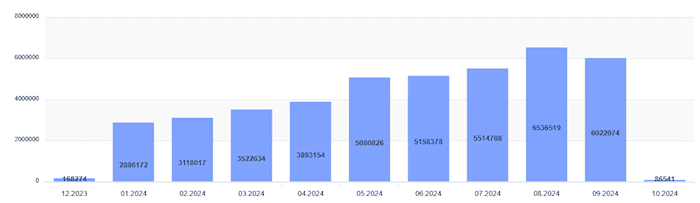
Image: Gateway usage / requests at publizer® since December 2023
The technical migration process followed a structured plan
- Parallel setup of the new server: The new server was set up in parallel to the existing system and equipped with a special server architecture that is optimized for processing large amounts of data.
- Hard disks with high read/write capacities (NVMe)
- Sufficient memory for the database
- Use of an FTP server for data exchange: To ensure seamless transfer of the existing article data, an FTP server was set up to exchange data between the old and the new server.
- Adjustment of the deployment pipeline: The continuous integration/continuous deployment (CI/CD) pipeline was adjusted to set up the article module on the new server and use the new database.
- Routing change: The routing of requests was finally changed to the new IP address by changing the DNS configuration. The time-to-live (TTL) settings were reduced to a minimum in order to make the changeover as smooth as possible.
- Optimization of the database in terms of statistics, fragmentation, tempdb settings, memory usage, etc.
Technical challenges
Several challenges had to be overcome during the entire migration. The biggest challenge was coordinating all the individual steps in order to minimize platform downtime. Even if all other modules can be used thanks to our architecture and are not affected by the migration, the article module should only be unavailable for a short time. The actual switchover process was therefore carried out in the late hours of the night in order to keep the impact on ongoing operations to a minimum.
Another technical aspect was the optimization of the TTL settings. By reducing the TTL value to just a few minutes, it was possible to ensure that the switch to the new server was adopted promptly by all DNS servers worldwide. The decisive factor for our customer portals was our API gateway. As soon as the gateway was able to process the new IP address, the content from the article module was available to all portals again. For most of them, no change was therefore noticeable due to optimal caching on the website.
Positive effects of the migration
The migration of the article module to the new server brought noticeable improvements for our customers:
- Improved performance: clients with large data volumes, such as the news portals of 021 Media, now benefit from noticeably faster response times. Requests that previously took several seconds are now processed in fractions of the time.
- Reduced load on the previous server: The "old" server was significantly relieved, which meant that other modules and functions of the platform also benefited from the migration.
- Increased stability: The separate processing on the new server leads to better load distribution and increases the overall stability of the platform.
You are welcome to try this out for yourself or have us show you in a demo appointment. If you are interested in a detailed insight into our new system architecture and the technical optimizations, we cordially invite you to a non-binding demo appointment.